
How to Floss With Braces: Complete Guide to a Healthy Smile
Braces are an exciting step toward a beautiful smile, but it also means adapting your oral hygiene routine. Flossing with braces can be a greater challenge than before, however it’s an integral part of braces care for teens and anyone else serious about keeping their smile healthy and protected.
Regular flossing with braces is essential because it removes the food particles, plaque, and bacteria that can cause tooth decay, gum disease, and cavities. If you’re going through all of the discomfort and cost of getting braces for a better smile, you sure don’t want to lose it over these diseases.
But flossing with braces creates an extra challenge because brackets and wires create new hiding spots for food particles and plaque buildup. Today’s guide will provide clear, easy-to-follow instructions, and recommend the best tools to make flossing with braces a seamless part of your daily routine.
Plaque removal with braces doesn’t have to be a chore. Below we’ll cover our orthodontic flossing tips, as well as the best way to floss braces.
Stay on top of your dental health with Absolute Dental. Book an appointment online now.
The Importance of Flossing With Braces
There are a number of reasons why flossing, with or without braces, is particularly important for overall oral health.
1. Plaque Removal
Braces create more surface area for plaque to accumulate. Plaque is the film created by your food and the natural bacteria in your mouth that causes cavities and gum disease. Brushing alone isn’t enough to remove plaque from the interdental spaces and along the gum line.
2. Preventing Gum Disease
Gum disease is a serious condition that can lead to all kinds of problems, including the loss of teeth. If plaque builds up, it can cause gingivitis or inflammation of the gums, which is an early stage of gum disease. Left untreated, gingivitis can lead to more serious oral health problems.
3. Preventing Tooth Decay and Cavities
Trapped food debris and plaque lead to the formation of acids that erode tooth enamel, causing tooth decay and cavities. Flossing under braces wire, flossing back teeth with braces, or even using floss picks for braces can help prevent tooth decay and cavities.
4. Maintaining Overall Oral Health
Many people don’t realize how close oral health is to overall physical health. Poor oral health can even cause serious health issues, such as heart disease and diabetes. Flossing is a critical component of a comprehensive braces oral hygiene routine, alongside brushing with fluoride toothpaste and using mouthwash.
Flossing Tools for Braces: Finding the Best Method for You
There isn’t a single best way to floss braces or a best dental floss for braces, but there are many techniques that work well.
The ideal method depends on personal preference and comfort:
- Floss threader for braces: This is a simple flexible plastic tool, with a small loop that allows you to thread dental floss behind your dental wire. This is one of the most powerful tools to prevent gum disease with braces.
- Super floss for braces: Super floss is specifically designed for people with braces and has three parts. It has a stiff end that works like a threader above, a regular floss section, and a spongy part for getting around braces wires and connectors.
- Waterpik for braces: A waterpik is like flossing but with water. It uses a pressurized stream of water to clean between teeth and dental appliances. These can even be a good choice for people who have trouble flossing for other reasons.
- Regular flossing for braces: Regular flossing can be quite difficult with braces. However, if there are no other tools available at the moment, you should try the best you can with what you have.

Regular Price:
$179
With this offer, there’s no excuse not to get back on track! Schedule a complete exam and x-rays for only $39 and ensure you have a beautiful healthy smile.
Hear From Our Patients
thank u for taking care of my boys :)
I love their Orthodontist office Dr. Askin is a great man great staff as well thank u for taking care…
They make sure you're in no pain when they do teeth fillings
They staff is so caring and they always try and get me in as fast as possible also they make…
Great atmosphere and customer service!
One of the best experience I've have with Absolute Dental. I love the customer service that is given to all…
We have been going here for a few years now. This is where we plan to keep coming!
We have been going here for a few years now. The staff is very nice and helpful . I appreciate…
Same day teeth cleaning and a teeth whitening
I had a toothache, got that taken care of same-day with teeth cleaning and a teeth whitening. If you need…
Best dental care I have received in a long time.
Best dental care I have received in a long time. They explain everything and were very kind. They helped me…
Flossing Braces Step by Step
Method 1: Flossing With a Floss Threader
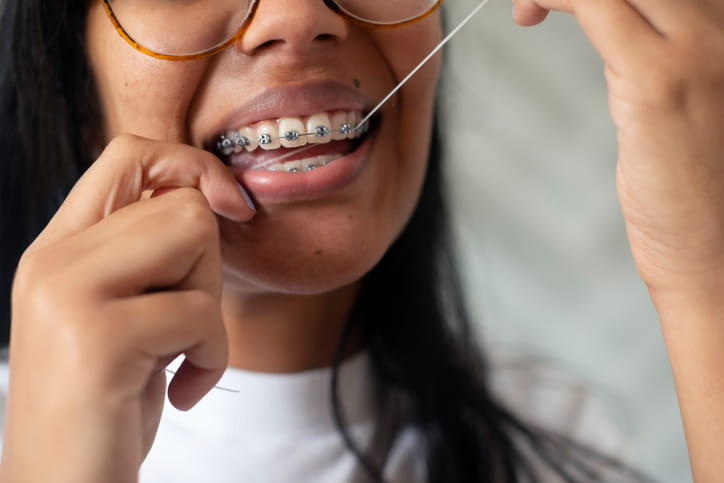
The floss threader is a small, flexible plastic tool with a loop.
Step-By-Step Guide
- Step 1 – Thread the floss: Take a piece of dental floss (12 to 18 inches) and thread it through the loop of the threader.
- Step 2 – Guide the threader: Gently guide the tip of the floss threader under the main archwire of the braces.
- Step 3 – Floss the tooth: Remove the threader and wrap the floss around the sides of one tooth. Use your index fingers to gently move the floss up and down, against the side of the tooth and below the gum line.
- Step 4 – Repeat the process: Carefully pull the floss out and repeat the process for the next tooth. This process needs to be repeated for every interdental space in the entire mouth.
Pros of a Floss Threader
- Effective at removing plaque.
- Inexpensive and easy to find.
Cons of a Floss Threader
- Can be time consuming.
- Requires a bit of practice to master.
- Some people find it cumbersome.
Flossing with braces in Las Vegas? See our orthodontists for help.
Method 2: Using a Water Flosser
A Waterpik water flosser or oral irrigator is a device that uses a pressurized stream of lukewarm water to dislodge food particles and plaque.
Step-By-Step Guide
- Step 1 – Fill the reservoir: Fill the reservoir with warm water. You can also add a small amount of mouthwash.
- Step 2 – Choose the tip: Attach the orthodontic flosser tip (or a general purpose tip).
- Step 3 – Set the pressure: Start with a low pressure setting.
- Step 4 – Position the tip: Lean over the sink and place the tip in your mouth.
- Step 5 – Clean around the brackets: Direct the stream of water at the gumline and between the teeth, pausing to clean around each bracket.
- Step 6 – Work through your mouth: Follow the gum line from one side to the other, making sure to clean both the front and back teeth.
Pros of a Water Flosser
- Quick and easy to use.
- Effective for removing food debris and bacteria.
- Gentle on the gums and braces.
- Excellent for reaching hard-to-reach spots.
Cons of a Water Flosser:
- Initial cost can be higher than traditional floss.
- Can be messy if not used over a sink.
Method 3: The Power of Super Floss
Super floss is a specialized floss with three parts: a stiff end for threading, a spongy section for cleaning, and a regular floss section.
Step-By-Step Guide
- Step 1: The stiff end acts like a built-in floss threader.
- Step 2: Guide the stiff end under the archwire.
- Step 3: Use the spongy section to clean the larger interdental space and around the brackets.
- Step 4: Use the regular section to clean below the gum line.
Pros of Super Floss
- Combines the functionality of a floss threader and traditional floss.
Cons of Super Floss
- Can be more expensive than regular floss.
Other Helpful Tools and Tips
- Dental tape: A wider, flatter version of floss that some find easier to grip and maneuver. It’s beneficial for cleaning more surface area than regular floss.
- Orthodontic flossers: These pre-threaded floss picks are designed specifically for braces and can be a more convenient option for a quick clean.
- Brushing: Brushing is a key part of your oral health routine. You should brush after every meal to remove food and plaque before flossing.
- Rinsing: Use an antibacterial mouthwash after brushing and flossing to rinse away any remaining bacteria and food particles.
- Don’t forget the basics: Be gentle with your gums, see your orthodontist regularly, get a checkup at your dentist every six months or as directed, and the process will become second nature with practice.
General Tips for Flossing with Braces
You should floss at least once a day, ideally at night to remove all the food debris from the day. Flossing before brushing is often recommended to loosen food and plaque, allowing the toothbrush to remove it more effectively.
Schedule Regular Cleanings With Absolute Dental
Even with braces, you should maintain your regular dental cleaning appointments, in addition to orthodontic check-ups. For either, schedule an appointment with Absolute Dental today.
We Accept Most Dental Insurance
Absolute Dental is a preferred provider for most insurances, unions, and hotels that include: Aetna, Ameritas, Boon-Chapman, Caesars Palace, Cigna, Delta Dental, Diversified, Geha, Guardian, Harrah’s, HealthSCOPE Benefits, Health Plan of Nevada (HPN), Humana, Liberty, Met-Life, MGM-MIRAGE, Premier Access, The Standard, Station Casinos, Teachers Health Trust, United Concordia, United Healthcare, Venetian, and The Zenith. We also accept Medicaid.
If you do not see your dental insurance listed here, just give us a call to confirm!
No Insurance? No Problem. Try our Smile Saver Program
Every person’s situation is different. If you don’t see your health insurance here, or if you do not have dental insurance, we can help you!
Call us now to discuss your situation and discover what options are right for you.
(844) 8-SMILE-NOW




















FAQ
You can, but it’s difficult and other methods such as super floss, floss threaders, and water flossers are much easier.
The metal wires, brackets, and other appliances can actually be quite sharp. When you floss, the floss often rubs up against these sharp edges, shredding it. If this happens it’s okay, and not cause for concern.
If you don’t floss with braces, you run the risk of gum disease, cavities, and other oral health issues, due to plaque buildup on the teeth. Even with braces, you should floss every day.
A Waterpik is a great tool for people with braces and other issues affecting flossing. However, it may not remove all plaque and should ideally only be used for a short time, and in conjunction with other flossing methods mentioned above.
The best way to clean your back teeth is by using a floss threader or super floss to reach under and around wires. A water flosser can also be helpful to clean these hard to reach places.
Your dentist or your orthodontist can tell you if there are places within your mouth that you aren’t reaching effectively.